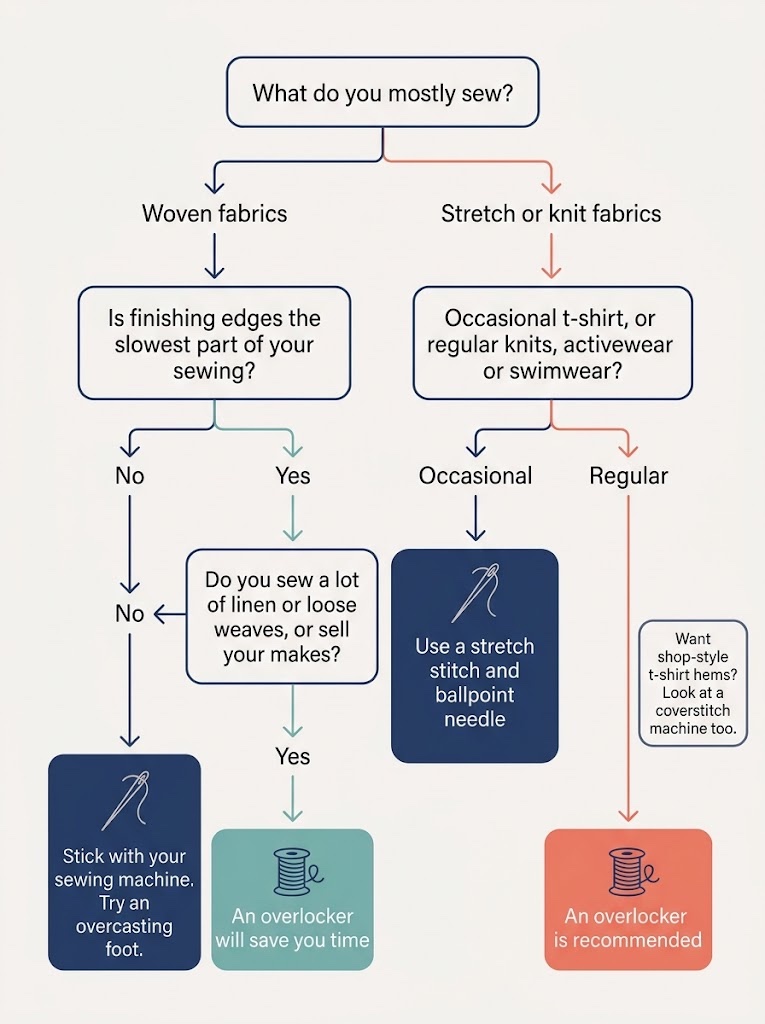
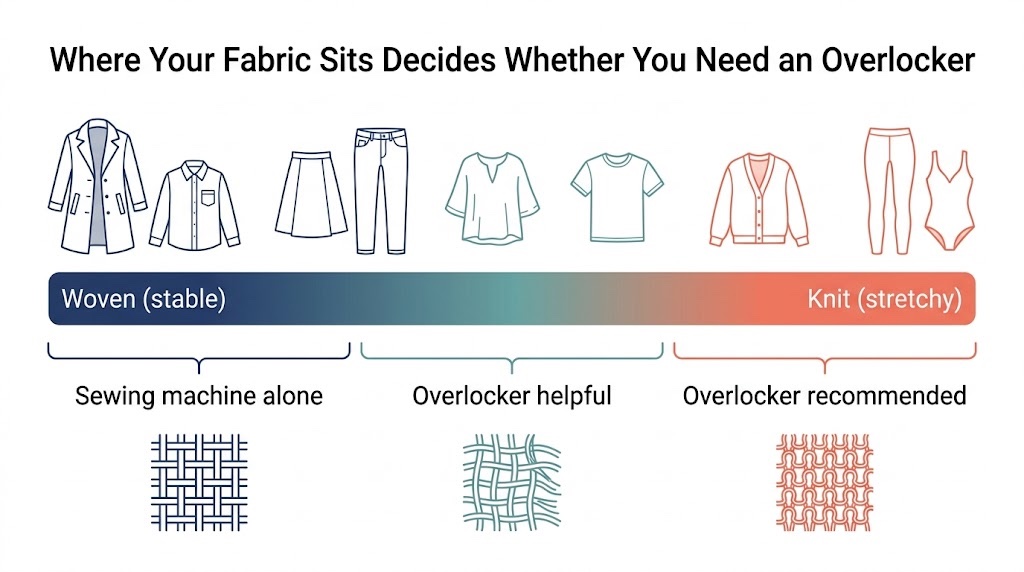
Do I need an overlocker to make clothes? Increasingly, yes. More and more fabrics have some stretch, with elastane (Lycra) blended into everything from jersey to denim and cotton shirting, and the more stretch a fabric has, the more an overlocker earns its place. It’s most useful when you sew jersey, activewear or swimwear regularly, when finishing edges takes longer than sewing the seams, or when you make clothes to sell. For non-stretch wovens, a sewing machine can still sew and neatly finish dresses, shirts, skirts and lined jackets on its own.
The table below gives a verdict for each type of garment, so you can check it against what you actually sew.
Which Clothes Can You Make Without an Overlocker?
Anything made from non-stretch woven fabric can be finished well on a sewing machine alone. Stretch fabrics are where a sewing machine starts to compromise, because a standard seam has less give than the knit around it and can snap when the garment is pulled on.
| Garment | Sewing machine finish | What an overlocker adds | Overlocker needed? |
|---|---|---|---|
| Lined jackets and coats | Lining hides the seams, so minimal finishing is needed | Very little | No |
| Unlined woven dresses and skirts | French seams, bound edges or overcast stitch | Speed on long seams | No |
| Shirts and blouses | Flat-felled or French seams | Speed and less pressing | No |
| Jeans and trousers | Flat-felled seams or overcast stitch | A neater inside and less bulk in denim | Optional |
| Linen and loose weaves | Bound or French seams, as edges fray fast | Fast, secure edges | Helpful |
| Jersey t-shirts and tops | Stretch stitch or narrow zigzag | Seams that stretch and stay flat | Recommended |
| Leggings, activewear and swimwear | Possible, but seams may pop under stretch | Durable stretch seams and differential feed | Recommended |
| Knitted cardigans and sweater knits | Difficult, as edges ladder and curl | Edges wrapped before they unravel | Recommended |
| Clothes you plan to sell | Achievable but slow | A shop-standard finish at speed | Recommended |
If most of what you sew sits in the top half of the table, a good household sewing machine covers everything you need. The finishes it relies on, such as French and flat-felled seams, have been used on quality clothing for far longer than domestic overlockers have existed.
Fine fabrics don’t fit neatly into one row. On silk and chiffon, a French seam sewn on a sewing machine is the classic finish, yet an overlocker’s rolled hem gives a delicate, even edge on a scarf or frill. JUKI ambassador Mercedes Ferrari-Plumridge sews silk chiffon on her JUKI machines, so fine fabric is no reason to rule an overlocker out.
How Do You Finish Seams Without an Overlocker?
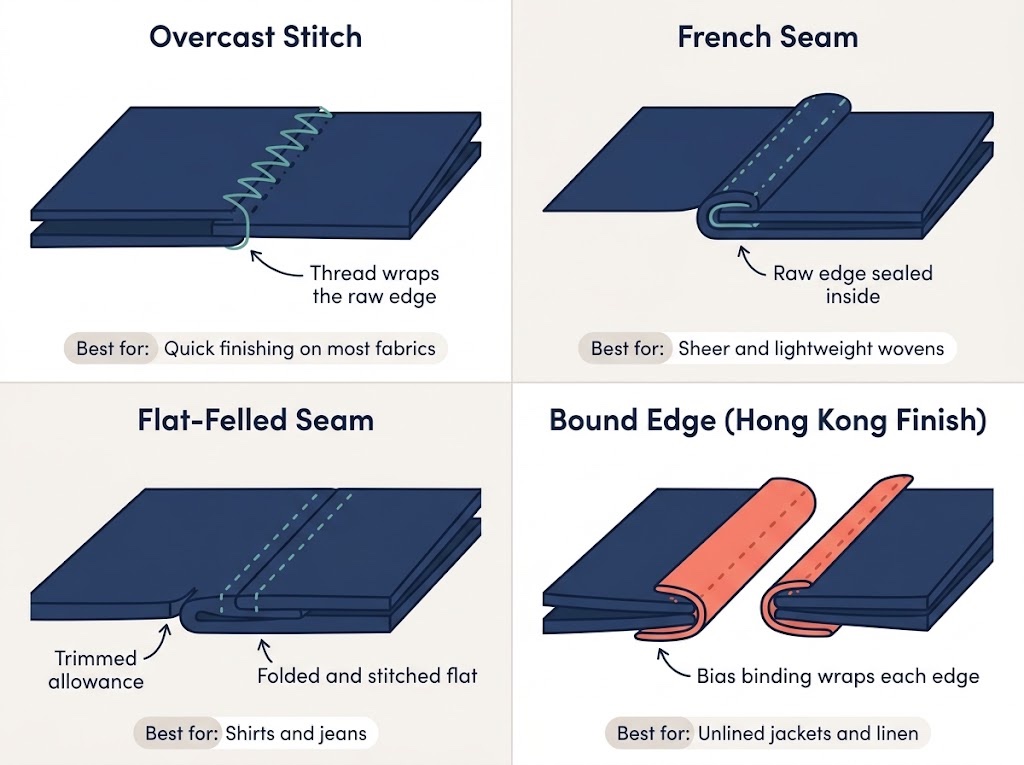
Use an overcast or zigzag stitch with an overcasting foot for speed, or enclose the raw edge inside the seam itself with a French or flat-felled seam. Which one to choose depends on the fabric and on whether the inside of the garment will be seen.
Overcast stitch. On most JUKI HZL series machines, the quickest finish is an overcast stitch sewn with the Overcasting Presser Foot. A guide on the foot sits against the raw edge, so the stitch wraps over it instead of pulling the fabric into a ridge underneath, a problem known as tunnelling. The foot fits HZL-DX, G, H, NX and UX series machines.
French seam. Sew the seam with wrong sides together, trim close, then fold and sew again with right sides together so the raw edge is sealed inside. It suits sheer and lightweight wovens, where any edge finish would show through.
Flat-felled seam. One seam allowance is trimmed, the other folded over it and stitched flat, giving a strong seam that looks tidy from both sides. It’s the finish you’ll find on most shirts and jeans.
Bound edge (Hong Kong finish). Each seam allowance is wrapped in a strip of bias binding. It’s slower than the other methods, but it gives an unlined jacket a high-end inside and stops linen and other loose weaves fraying in the wash.
Stretch fabric. Sewing jersey without an overlocker works if the thread can move with the fabric: use a stretch stitch or narrow zigzag and a ballpoint or stretch needle. A walking foot feeds the layers evenly so seams don’t wave. JUKI ambassador Jen Hogg points out that the NX7 Kirei has one built in.
When Does an Overlocker Make Things Worse?
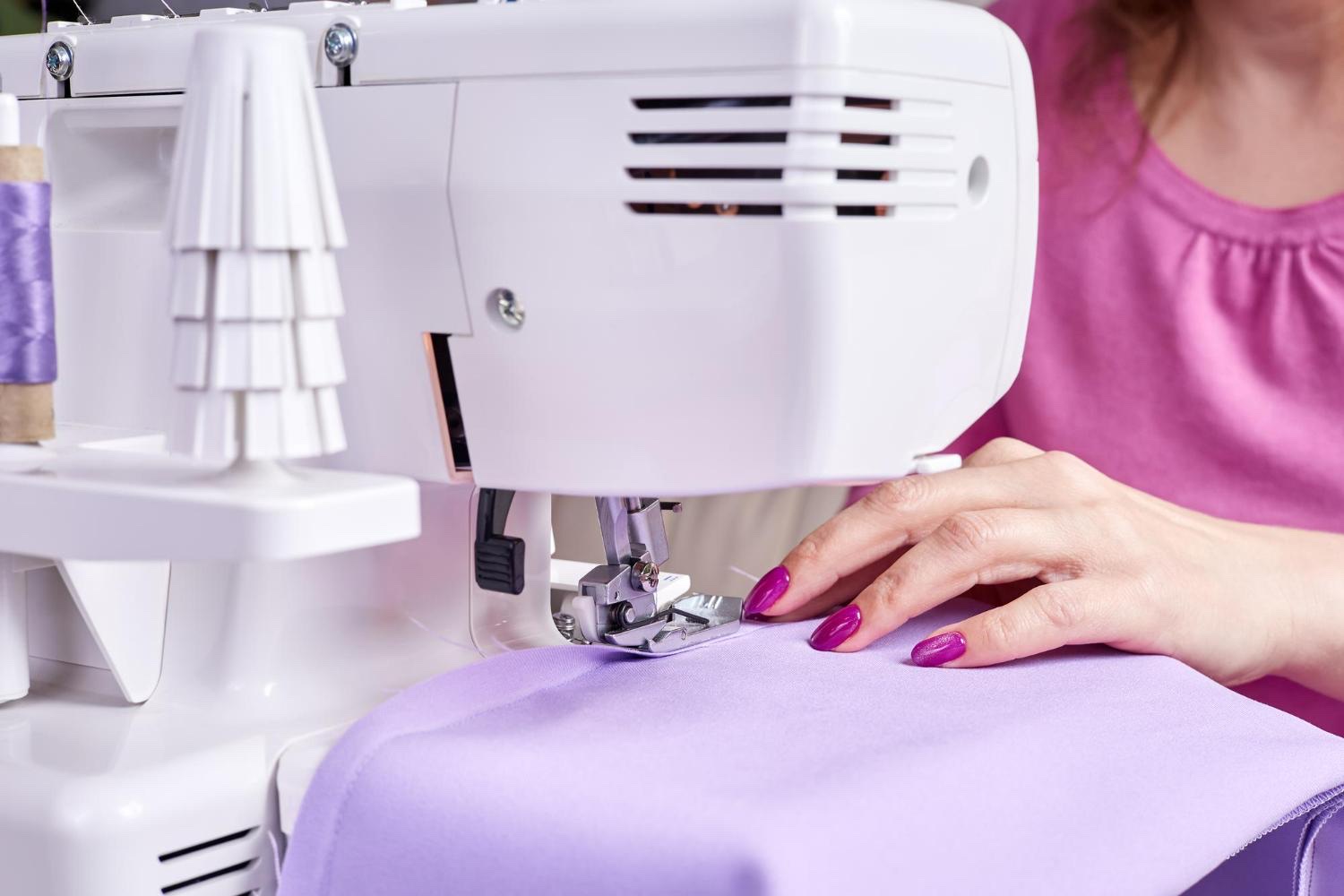
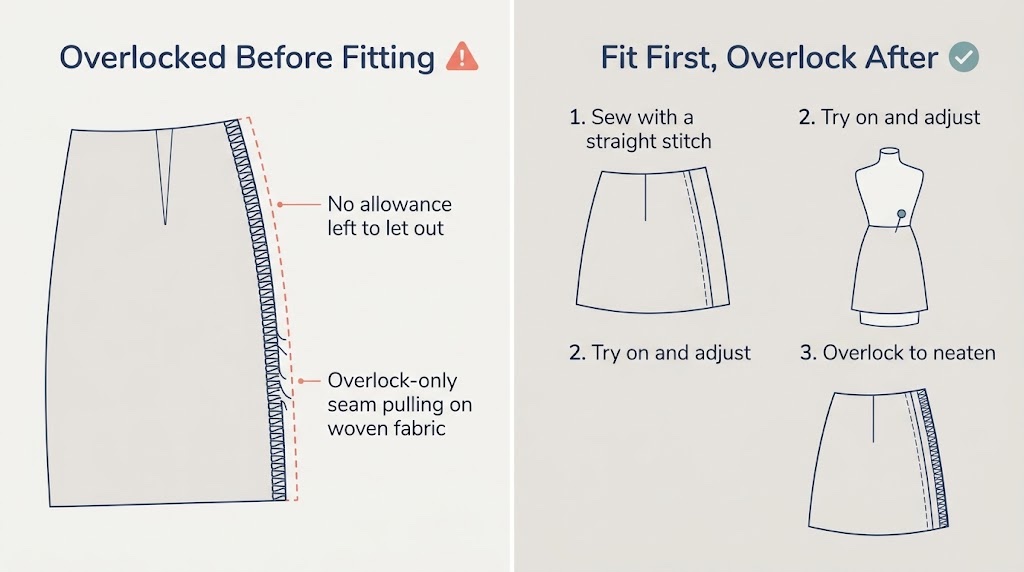
An overlocker makes things worse when it’s used for jobs a sewing machine does better: seaming woven garments on the overlocker alone, trimming seam allowances before you’ve checked the fit, or expecting it to hem a t-shirt.
On woven fabric, a seam sewn only on the overlocker can pull away from the weave under strain, most noticeably at the side seams of fitted trousers and across the back of a jacket. Sew the seam with a straight stitch on your sewing machine first and use the overlocker to neaten it.
The overlocker’s knife also trims the seam allowance as it sews. That’s fine once a garment fits, but it removes the fabric you’d need to let a waist or bust out. Tack or baste, try it on, then overlock.
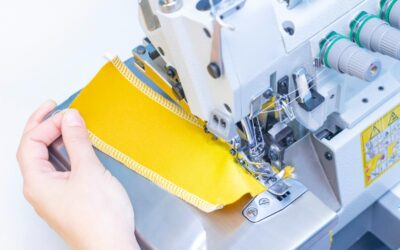
Finally, a standard overlocker can’t sew the twin-needle stretch hem you see on shop-bought t-shirts. That’s a job for a coverstitch machine. For a fuller picture of what an overlocker can and cannot do, see our comparison of overlockers and sewing machines.
When Is an Overlocker Worth Buying?
An overlocker is worth buying when stretch fabrics are a regular part of what you sew, when finishing edges is the slowest part of your projects, or when you’re selling what you make. Answer these honestly about the last few things you made:
- Most of your projects use jersey, rib or other knits, not an occasional t-shirt.
- You want to make leggings, activewear or swimwear that has to survive stretching and repeated washing.
- You spend longer finishing edges than sewing the seams themselves.
- You sell your makes, and customers will see the inside.
If none of these applies, put the money towards fabric or a presser foot for your sewing machine instead.
If you tick two or more, the MO-644D is JUKI’s entry model, sewing with two, three or four threads and including a built-in rolled hem and differential feed for stretch fabrics. If threading is what puts you off, the MO-1000 Air Threader threads the loopers with a push of air. The full range is on the domestic overlockers page.
A well-finished seam also makes clothes easier to repair, which matters: WRAP’s research on clothing longevity found that repairing clothing extends its life by around 1.3 years.
Threading, stitch quality and noise are easier to judge in person than from a product page, so try a machine before you buy. JUKI UK machines are available to try through UK stockists and at sewing shows around the country.