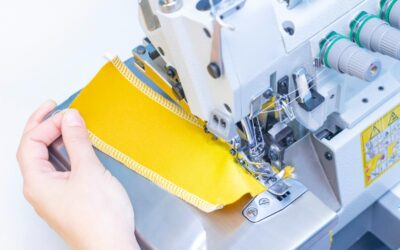
To sew a rolled hem on an overlocker, you change three settings from a standard overlock: pull the stitch finger back, shorten the stitch length and tighten the lower looper tension. That is the starting point our UK support team gives owners of the JUKI MO-654DEN and the MO-1000 Air Threading Overlocker. Sew a test strip on a scrap of the same fabric, then fine-tune one dial at a time.
Our guide to overlocker stitch types explains how the stitch forms. This article covers the rolled hem settings on an overlocker, model by model, and the fixes when an edge won’t roll.
How Do You Set Up an Overlocker for a Rolled Hem?
A rolled hem uses one needle, a short stitch and enough lower looper tension to pull the fabric edge over. On a JUKI MO overlocker it takes five steps, with no change of foot or needle plate.
- Take out the left needle. Thread for a 3-thread stitch on the right needle, or 2-thread if your machine converts. The right needle gives the narrowest roll. On the MO-654DEN and MO-644D, the left needle gives a wider rolled edge if you want one.
- Pull the stitch finger back. On most JUKI MO models this is the rolled hem lever on the needle plate, which you move towards you. With the finger out of the way, the fabric edge has nothing to sit flat around, so it curls under as it’s stitched.
- Shorten the stitch length. JUKI’s rolled hem setting on the MO-654DEN is 1.5mm, against 2.5mm for a standard overlock. Shorter stitches sit close enough together to cover the edge.
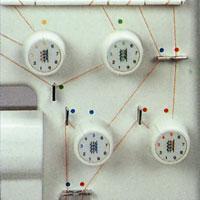
- Tighten the lower looper tension. The lower looper pulls the upper looper thread round the edge and underneath, and that pull is what rolls it. Start from the normal setting marked on the dial and turn it up.
- Sew a test strip. Use the same fabric, grain and number of layers you’ll be hemming. Change one dial at a time so you know which change made the difference.
Thread matters too. A fine thread in the upper looper gives a slim, neat roll, while a thick one makes the hem bulky.
Rolled Hem Settings on JUKI MO Overlockers, Model by Model
Every JUKI MO overlocker sews a rolled hem. What changes up the range is how much of the adjusting you do and how much the machine does for you.
| Model | Switching to rolled hem | Who sets the tension |
|---|---|---|
| MO-644D | Lever on the needle plate, moved towards you | You: shorten the length, tighten the lower looper |
| MO-654DEN | Lever on the needle plate, moved towards you | You: shorten the length, tighten the lower looper |
| MO-214D | Built-in fingertip control, no plate or foot change | You |
| MO-1000 | As the MO-654DEN | You: same adjustments |
| MO-2000QVP | Choose rolled hem and follow the front screen | You, with the screen showing the settings |
| MO-2500 Sumato | Selection lever to roll hemming, cutting width dial at 2.5 to 3.5 | A roll hemming tension lever |
| MO-3500 Sumato | Turn the stitch selector dial | The machine, automatically |
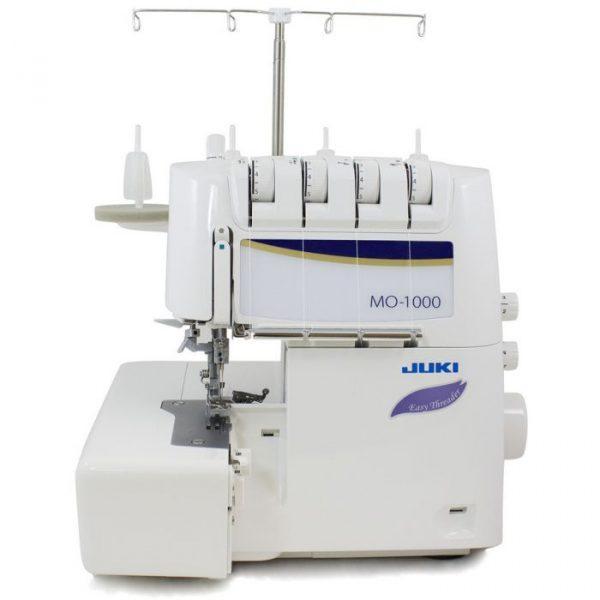
Our advice for the MO-654DEN and MO-1000 is the same. Air threading on the MO-1000 doesn’t change the settings, but it lets you thread the loopers in any order, which makes swapping to a finer hem thread much quicker.
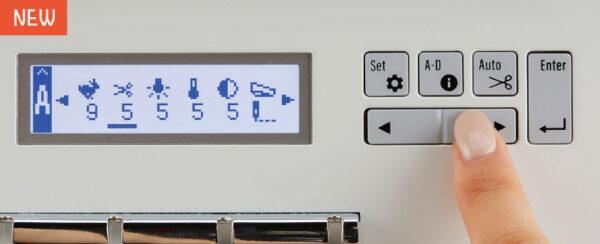
The MO-2000QVP has an instruction screen on the front that shows the more detailed adjustments, so you don’t need to look through the manual. JUKI’s own MO-2000QVP page lists set-up guidance for 15 stitches on that screen, including a frill 3-thread rolled hem.
The MO-3500 Sumato takes the dials away altogether. Its tensions are fed automatically, so you turn the stitch selector dial to rolled hem and adjust nothing else.
Which Fabrics Won’t Take a Rolled Hem?
Anything too heavy for the edge to roll. Canvas, vinyl and denim are the ones we steer people away from, because the fabric is too thick or stiff to curl inside a stitch around 2mm wide.
This is where the usual advice to tighten the lower looper stops working. On heavy fabric, more tension won’t roll the edge. It just pulls the stitches tight over an edge that stays flat.
Rolled hems suit fine, light fabrics, which is how Gütermann’s guide to overlock seams describes the stitch. Chiffon, georgette, voile, lawn and lightweight jersey all roll well. Mid-weight cottons and linens sit in between: some roll neatly, others leave a lumpy edge, so test a strip before you commit to a whole hem.
For heavier fabric, finish the edge with a standard 3 or 4-thread overlock, then turn it and topstitch. For hems on knits, a coverstitch machine such as the MCS-1800 gives the stretchy, ready-to-wear finish you see on T-shirts.
Why Won’t My Overlocker Rolled Hem Roll?
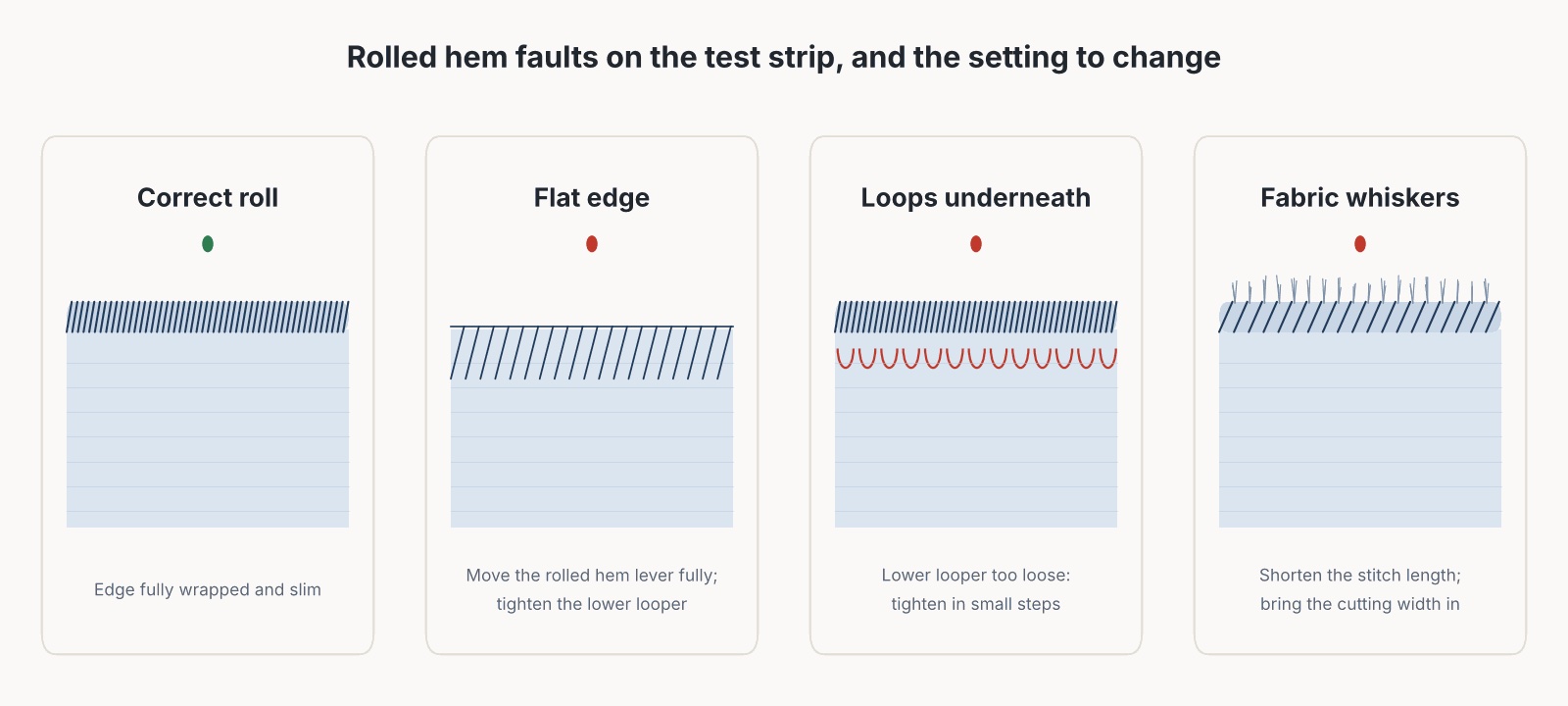
A rolled hem that won’t roll usually has one setting still on standard overlock, most often the stitch finger or the lower looper. Check your test strip against these faults.
- The edge stays flat and looks like a narrow overlock. The stitch finger is probably still in place. Check the rolled hem lever has moved all the way, then tighten the lower looper a little more.
- Loops show on the underside. The lower looper is too loose to pull the upper looper thread round. Tighten it in small steps.
- Fabric whiskers poke through the thread. The stitches are too far apart, or too much fabric is being rolled in. Shorten the stitch length, then bring the cutting width in so the knife trims closer to the needle. On the MO-2500 Sumato, JUKI sets the cutting width dial between 2.5 and 3.5 for rolled hems.
- The hem rolls in some places but not others. This is usually the fabric. Seam allowances and heavier patches resist rolling, so trim bulky seams where the hem crosses them, or switch to a different finish on heavy cloth.
- Woven fabric puckers or waves along the hem. Differential feed set above neutral gathers the fabric as it’s sewn. Set it to N on wovens, and save the higher setting for a lettuce edge on stretch fabric.
- The thread keeps snapping. The tension is too tight for the thread. Ease the looper back a step and test again.
Do You Need a Rolled Hem Foot on a JUKI Overlocker?
No. JUKI MO overlockers switch to rolled hem with a lever or dial and sew it with the standard foot, so there’s nothing extra to buy.
The Juki Rolled Hemming Foot in our accessories range is a sewing machine foot. It folds the fabric edge over and stitches it down, giving a narrow turned hem rather than an edge wrapped in thread. It’s a good choice on fine fabric if you prefer a stitched hem, or if you don’t own an overlocker yet. Our overlocker vs sewing machine comparison covers where the two overlap.
For other overlocker effects, such as beading, piping or cording, browse our overlocker feet and accessories.
How Easy Is a Rolled Hem on Each JUKI Overlocker?
The most common rolled hem question our support team hears isn’t about a fault. It’s “how easy can this machine do a rolled hem?” Every JUKI MO model sews one; the difference is how much you adjust.
- Happy to move a lever and set two dials: the MO-654DEN.
- Same settings, but threading the loopers puts you off: the MO-1000 Air Threader.
- Want the settings shown on the machine: the MO-2000QVP.
- Want to turn one dial and sew: the MO-3500 Sumato.
If you can, try a rolled hem before you buy. The University of Kentucky’s guide to selecting a serger recommends checking rolled edges when testing a machine, because some models need parts changing to sew one.
For help setting up a rolled hem on your model, our UK team offers technical support by phone, email and video call through our contact page. You can also see the full range of JUKI overlockers at JUKI UK.